Volume 4, 2025
EuCAP 2025 SPECIAL ISSUE
A Scalable Differential Series-fed Dipole Array for D-band Radar in Wafer-Level Package Technology
Authors:
Martijn de Kok, Paola A. Escobari Vargas, Elmine Meyer, Friedrich Müller, Tanja Braun, Ad C. F. Reniers, Ulf Johannsen
Abstract: This article presents the design and characterization of a scalable series-fed differential Antenna-in-Package (AiP) design, demonstrated as a four- and a six-element reflector-backed linear dipole array that has been realized in a resin-based fan-out wafer-level package technology. The simulated four- and six-element designs achieve −10 dB input reflection bandwidths of 5.5 and 5.9 percent, realized gains of 14 and 15.4 dBi, and side-lobe levels of −10.7 and −12.1 dB, respectively. Frequency scanning is limited to ±4° throughout the bandwidth for both designs. The realized samples were characterized through probed measurements in a state-of-the-art millimeter-wave anechoic chamber. After taking into account the influence of the RF probe on antenna performance, the measurements corroborated the simulated results. The presented designs represent a beyond-state-of-the-art contribution in gain-to-area ratio to the currently limited number of high-gain differential AiPs at D-band found in literature. This article expands upon a 2025 EuCAP paper with more detailed descriptions, a scalability study, and a simulated feasibility demonstration of a scanning array implementation for further gain enhancement and a ±45° scan range.
EuCAP 2025 SPECIAL ISSUE
Metastructure-Enabled Radiation Pattern Unroundness Improvement for Antennas in Complex Electromagnetic Environments
Authors:
Zhi Ning Chen, Bo Zhang, Huiwen Sheng
Abstract: Radiation pattern roundness is critical for achieving reliable and uniform coverage in wireless communication systems. However, antennas operating in complex environments—such as those mounted off-center on finite platforms or enclosed within dielectric covers—often suffer from pattern distortion due to asymmetric boundary conditions and unwanted guided waves. This paper investigates metastructure-based solutions to mitigate radiation pattern unroundness for both vertically and horizontally polarized antennas. For vertically polarized monopoles, impedance surfaces and Henge-like metarings are designed to suppress edge-diffracted currents and enhance omnidirectionality. For horizontally polarized dipole-based antennas, a uniaxial anisotropic meta-cover is proposed to suppress guided wave propagation within dielectric enclosures. The proposed metastructures significantly improve radiation pattern unroundness to lower than 1.9 dB and enhance coverage efficiency up to 84.7%. These methods provide a viable pathway for improving antenna performance in confined or asymmetrical settings, supporting the development of high-capacity, robust wireless networks.
EuCAP 2025 SPECIAL ISSUE
Multi-RIS-assisted Railway Communications in Tunnel using CloudRT simulator
Authors:
Aline Habib, Ammar El Falou, Charlotte Langlais, Marion Berbineau
Abstract: High data rates are increasingly required in railway communications to support services such as video streaming, passenger connectivity, real-time monitoring, and safety-critical applications. Although millimeter-wave (mmWave) frequencies meet these demands due to their large available bandwidth, their strong sensitivity to blockage significantly limits their coverage, particularly in confined environments such as tunnels, where tunnel walls, ceilings, and train carriages can obstruct signals. In this context, Reconfigurable Intelligent Surfaces (RIS) have emerged as a promising solution to overcome signal-blocking issues by enabling additional propagation paths. However, due to the high signal attenuation in tunnel environments, a single RIS is generally insufficient to ensure reliable communication throughout the tunnel. Consequently, multiple RISs must be deployed along the tunnel to maintain an acceptable received signal. This paper investigates the effectiveness of multi-RIS-assisted systems in tunnel scenarios. An optimization algorithm is proposed to determine the optimal number and placement of RISs within the tunnel. A ray-tracing simulator, CloudRT, is used to generate realistic channel coefficients. As RIS functionality is not integrated into the simulator, we extend it by modeling the RIS as a virtual receiver-transmitter phased array antenna. The simulation results show that in tunnel scenarios where the direct Tx–Rx link is blocked by a train, placing the RIS on the tunnel’s ceiling yields better performance than mounting it on the tunnel’s walls. Moreover, the Rx can achieve a good signal-to-noise ratio (SNR) using a reasonable number of RISs of practical size.
EuCAP 2025 SPECIAL ISSUE
A Comparative Analysis of 3D Printed Substrate and Laminate-Based Rectangular Patch Antennas at C-Band
Authors:
Saúl S. Carvalho, João R. Reis, Rafael F. S. Caldeirinha
Abstract: This paper presents a comparative study between 3D printed and laminate-based rectangular patch antennas, specifically designed to operate at 4.7 GHz. A total of five patch antennas, fabricated using additive manufacturing (AM) techniques and several materials as substrates (Nanoe Zetamix Epsilon filaments, PETG and PLA), are compared against four antenna prototypes made in well known laminate substrates (FR4, Rogers RT/duroid 5880, RO4350B, and RT/duroid 6010LM). For the 3D printed antenna prototypes, different metallisation techniques, including copper foil, silver spray, and silver cloth tape, were employed to enhance the electrical performance of the antennas. The results show that the 3D printed antennas performed reasonably well compared to their laminate counterparts, although several challenges were encountered, particularly related to manufacturing inconsistencies and the brittleness of the Zetamix filaments.

EuCAP 2025 SPECIAL ISSUE
Systematic methodology for cylindrical structural antenna design
Authors:
Raphael Notter, Sylvain Collardey, Ala Sharaiha, Loïc Bernard, Philippe Pouliguen, Paul Karmann
Abstract: This paper presents a methodology for the design of cylindrical structural antennas that operate using radial modes, making them efficient radiating elements. These antennas are directly integrated into cylindrical structures making them suitable for aerospace and automotive applications. The proposed approach enables the excitation of such a structure with a low-profile source and benefits from a larger resonant surface. A major challenge of these antennas is the appearance of higher-order modes when the structure’s size becomes large compared to the wavelength. However, radial modes remain largely unaffected by the cylinder’s length, making them particularly advantageous. To address this, we propose a novel method to excite radial modes on cylindrical structures with different radii and lengths. First, Characteristic Modal Analysis (CMA) is used to select the desired and undesired modes. Next, the excitation of these modes through slots is analyzed and optimized, followed by the feeding design using coaxial probes or aperture coupling feeding. Additional improvements such as parasitic slots are also explored. Different models are presented and simulations are conducted using a 3D full-wave solver. Prototypes for various sizes were fabricated. The results demonstrate that this approach enables seamless antenna integration into various cylindrical structures without compromising electromagnetic performance, even when the structure is significantly larger than the wavelength. This work highlights the potential for multifunctional systems.
EuCAP 2025 SPECIAL ISSUE
Low-Profile Lightweight X-Band PDHT Antenna for Earth Observation Satellite Constellations
Authors:
Luca Di Palma, Davide Maiarelli
Abstract: This paper presents the design, manufacturing and experimental characterization of a X-band Antenna (XBA) dedicated to Payload Data Transmission (PDT) for new Satellite platforms that will form constellations for Earth observation applications. The antenna is characterized by a reduced profile and minimized mass in order to fulfill stringent accommodation constraints, typical of Low Earth Orbit (LEO) medium-small platforms. Proposed design is based on a planar array of patch antennas implemented on a sandwich made of composite materials integrating also the antenna Beam Forming Network (BFN). Conducted and radiated measurements are carried out at different steps of an extensive space qualification campaign on first antenna model. The results demonstrate excellent RF performance fully in line with full-wave analysis. Furthermore, proposed technology is potentially attractive for a wide spectrum of LEO applications at different frequencies (e.g. GNSS, Inter-Satellite Links).
EuCAP 2025 SPECIAL ISSUE
Effective-Height Analysis of UWB Antenna Arrays for TDoA and PDoA Estimation
Authors:
Tobias Lafer, Michael Gadringer, Ulrich Muehlmann, Franz Teschl, Klaus Witrisal
Abstract: State-of-the-art low-power ultra-wideband (UWB) chipsets commonly rely on phase-difference of arrival (PDoA) and time-difference of arrival (TDoA) measurements for performing angle-of-arrival (AoA) estimations. But in real-world scenarios, the TDoA and PDoA measurements suffer from AoA-dependent phase and delay biases introduced by the receiver antennas. If not properly compensated, the accuracy of the final AoA estimates reduces. To assess such antenna influences, we extend effective-height-based analysis methods from standalone antennas to antenna arrays for simulation and measurement. Each antenna element is modelled as an LTI system, with its effective height as AoA-dependent transfer function. The obtained effective heights of the single antenna elements consider coupling effects between the antenna elements as well as objects in their vicinity. The proposed simulation and measurement procedures were applied to two different antenna pairs, one composed of directional antennas and one composed of omnidirectional antennas. We compare impulse responses as well as PDoA and TDoA estimates obtained from simulations and measurements to discuss influences of the measurement system as well as modelling uncertainties in the simulation. We found that effective heights and PDoAs correlate rather well between simulation and measurement for the investigated antennas. However, substantial differences were observed between simulated and measured TDoAs, which require further investigation.
EuCAP 2025 SPECIAL ISSUE
3D-Printed Dual-Band and Broadband Linear to Circular Polarizing Screen for K/Ka-Band Satellite Antennas With Feed-Aperture Integration
Authors:
Andrea Guarriello, Etienne Girard, Charalampos Stoumpos, Laszlo Sajti, Frederic Veron, Herve Legay
Abstract:
This paper presents the design, fabrication, and experimental validation of a dual-band linear-to-circular polarization converter based on a 3D frequency selective surface and tailored for K/Ka-band satellite communication systems. The proposed solution, based on a transverse electromagnetic (TEM) cell topology, is realized through additive manufacturing using Stereolithography Apparatus (SLA) combined with copper metallization, achieving a lightweight and low-loss structure with complex 3D geometries. The device, integrated directly on the the feed aperture, effectively covers both the transmit K-band (17.3–20.2 GHz) and receive Ka-band (27.5–30.0 GHz) sub-bands, demonstrating axial ratios (AR) below 1.1 dB in the TX and in the RX band, with reflection losses better than 17 dB. The polarizing screen demonstrates outstanding broadband or dual-band behavior under periodic boundary condition simulations (AR < 3 dB and IL < 0.25 dB in broadband mode; AR < 1.1 dB and IL < 0.15 dB in dual-band mode). This work represents a first step toward the direct integration of polarizing screens onto radiating apertures, enabling compact, high-efficiency antenna designs for future phased array platforms. The paper also discusses fabrication challenges, thermal reliability, and a sensitivity analysis confirming robustness against manufacturing tolerances, highlighting the potential of 3D printing for advanced satellite antenna subsystems.
EuCAP 2025 SPECIAL ISSUE
Measurement, Modeling and Realization of Mono-static 3D UAV RCS for ISAC Channels
Authors:
Guangcheng Yu, Zhiqiang Yuan, Wei Fan
Abstract: Realistic unmanned aerial vehicle (UAV) radar cross section (RCS) profiles are essential for integrated sensing and communication (ISAC) channel modeling, ensuring reliable prediction and evaluation of sensing performance. Despite advancements in UAV RCS research, the limited experimental data and the unestablished realistic UAV RCS model, particularly for 3D scenarios, have resulted in the unavailability of practical UAV RCS profiles. This study focuses on modeling and realizing UAV RCS based on an 3D UAV RCS measurement. First, we conduct mono-static 3D UAV RCS measurements in an anechoic chamber, covering a frequency band of 1.8 GHz to 18.2 GHz and azimuth angles of −90° to 90° (given the symmetry of the UAV) at three UAV elevation angles {0°, 90°, 180°}. Next, the measured RCS data are fitted to three well-known distributions: Rician, Gamma, and LogNormal. The analysis indicates that the Rician distribution is recommended for modeling UAV RCS based on the fitting performance. Detailed distribution parameters are provided for UAV RCS realization. Furthermore, a statistical evaluation of the UAV RCS based on the modeling results is performed, providing insights for UAV sensing prediction and assessment. Finally, the validated model is utilized to generate UAV RCS data, which exhibits a strong agreement with measured results. These findings facilitate the advancement of ISAC channel research and practical applications.
EuCAP 2025 SPECIAL ISSUE
Suppression of the Polarization-Dependent Antenna Carrier Effect in Phased Arrays with Electromagnetic Bandgaps for Airborne SAR Applications
Authors:
Diego Lorente, Markus Limbach, Bernd Gabler, Hector Esteban, Vicente E. Boria Esbert
Abstract: The polarization-dependent edge diffraction effects due to the interaction between the antenna and the carrier structure, that enables the antenna mounting on the aircraft, is presented in this paper. The resulting antenna carrier impact is experimentally verified, by means of measurements performed with the operational flight-certified L-band phased array antenna employed in the next-generation DLR bistatic airborne Synthetic Aperture Radar (SAR) sensor. Measured radiation pattern in elevation shows a main beam widening and gain reduction of approximately 1 dB for the vertical polarization, that becomes more sensitive to edge diffraction effects due to the electric field direction and the carrier geometry. On the other side, the performance of the horizontal polarization remains unaffected. In order to achieve a similar radiation response for both polarizations that is required in polarimetric SAR systems, the use of Electromagnetic Bandgaps (EBGs) is proposed. Making use of the surface wave suppression properties of EBGs, the induced currents on the carrier for the vertical polarization can be mitigated, thus reducing the resulting edge diffraction effects without affecting the performance of the horizontal polarization. The presented approach is validated with measurements placing EBGs on each side of the antenna carrier surface. This way, a comparable radiation features for both polarizations can be achieved, that become independent of the carrier structure.
EuCAP 2025 SPECIAL ISSUE
Slant-Polarized Coaxial Slot Antenna Using Gap Waveguide MLW Technology for Automotive Radars
Authors:
Reza Gheybi Zarnagh, Abolfazl Haddadi, Andres Alayón Glazunov
Abstract: This paper presents the design of a coaxial slot antenna utilizing gap waveguide (GW) multilayer waveguide (MLW) technology for automotive radar applications. The antenna employs a low-loss, air-filled coaxial transmission line, formed by stacking three distinct metal sheets. Its primary antenna element is a side-fed column featuring eight in-line slant slots, each pair excited via a coupling slot and intermediate cavity. To minimize leakage caused by small air gaps between the metal sheets, an electromagnetic bandgap (EBG) structure is incorporated along the transmission lines. The antenna supports dedicated transmit and receive channels for a multiple-input multiple-output (MIMO) automotive radar system. A five-layer structure progressively rotates the electric field orientation by 45° through intermediate cavities, enabling the slant polarization. The design achieves an impedance bandwidth of |S11| < −10 dB across the 76–81 GHz band allocated for automotive radar. With eight radiating slots, the antenna produces a peak gain of 13.7 dBi at 77 GHz.
EuCAP 2025 SPECIAL ISSUE
Scan Limitations of Open-ended Ridged Waveguide Apertures for Ka-band Satellite Communication Applications
Authors:
Sören Harms, Jean-Philippe Fraysse, Alessandro Garufo, Ulf Johannsen, Stefania Monni
Abstract: Open-ended ridged waveguide phased array antennas are of high interest for low Earth orbit satellite communication applications due to their high efficiencies and power handling capacities. This paper analyzes the scan limitations with respect to active matching, axial ratio (AR), and realized gain of circular and hexagonal waveguide apertures with three and six ridges for a Ka-band satellite downlink application. Strong degradation of the active reflection coefficient (ARC), the coupling coefficient to the terminated (cross-polarized) port of a polarizer, the AR, and the realized gain are observed at high scan angles and frequencies when using a large element periodicity near the grating lobe threshold. For the open-ended hexagonal six-ridged waveguide, the scan limitations are investigated in detail for several element periodicities. The degradations can be related to three conditions. First, the onset of higher-order Floquet modes leads to single-mode scan blindness associated with one of the two orthogonal fundamental waveguide modes. Second, a transmission zero of one of the two fundamental waveguide modes far outside the operational band, occurring when the phase constants of the fundamental waveguide modes align with those of the fundamental Floquet modes, is interpreted as surface wave propagation and results in an increased attenuation of the affected fundamental waveguide mode at the maximum operational frequency. Third, the onset of higher-order waveguide modes induces modal coupling between the fundamental and the first two higher-order waveguide modes. Each of these conditions results in unequal contributions from the two fundamental waveguide modes to the radiated field, thereby degrading the overall performance. These scan limitations can be mitigated by using open-ended ridged waveguides with an electrically short evanescent end-section, allowing for large element periodicities while meeting the AR requirements for Ka-band satellite communication applications.
EuCAP 2025 SPECIAL ISSUE
Angle-Resolved Channel Measurements at 28 and 160 GHz in Open Office Environment
Authors:
Mathis Schmieder, Alper Schultze, Niclas Kullig, Ramez Askar, Michael Peter, Wilhelm Keusgen
Abstract: This paper presents channel measurements and modeling at 28 and 160 GHz in an industrial-style open office environment with angular information at the receiver. Channel impulse response snapshots are captured at 135 measurement positions for both frequencies and are evaluated in terms of power metrics, delay, and angular characteristics. Frequency-dependent models for path loss, delay, and angular spread of arrival and K-factor are estimated, and large-scale parameter cross-correlations are evaluated. The measurements are compared to the 3GPP TR 38.901 channel model in the Indoor-Office and Indoor-Factory scenario. Results show that delay and angle spread are not frequency dependent in this environment although twice as many multi-path components were identified at 28 GHz compared to 160 GHz.
EuCAP 2025 SPECIAL ISSUE
Efficient Compact Single-Layer Metasurface RF Energy Harvesters for IoT Applications
Authors:
Raziyeh Sharifi, Anne Claire Lepage, Kyriaki Niotaki, Xavier Begaud
Abstract: In this paper, we extend our previous works on compact and efficient metasurface energy harvesters by introducing additional theoretical analysis, and measurement results for evaluating performance in finite arrays. Two metasurface harvesters are studied: a single-band design operating at 2.45 GHz and a dual-band design covering 2.45 GHz and 5.2 GHz (Wi-Fi bands), proposed for IoT applications. This paper introduces the concept of central rows in the finite array, which provides a more realistic and reliable metric for characterizing the capturing efficiency. For both designs, 5×4 finite arrays are analyzed. The simulated capturing efficiency of the central rows reaches 90% at 2.54 GHz for the single-band structure, and 74% at 2.5 GHz and 30% at 5.09 GHz for the dual-band design. Each proposed design has been analyzed independently, fabricated, and measured to verify its performance.
EuCAP 2025 SPECIAL ISSUE
Profile-Reduced S/X-Band Shared-Aperture Antenna Array with Frequency-Selective Surfaces
Authors:
Mohamed Räsänen, Juha Ala-Laurinaho, Andrea Di Giovanni, José Manuel Fernández Gonzalez, Alfonso Tomás Muriel-Barrado, Ville Viikari
Abstract: Shared-aperture antennas (SAAs) are becoming more popular due to their desirable traits such as miniaturization and multi-band operation. However, achieving adequate SAA performance often requires a high total antenna profile or costly manufacturing. In this work, we review the state-of-the-art SAAs and present the design concept and simulation results of a novel dual-circularly polarized SAA for satellite communications. The S-band element is realized with a band-to-band isolating dipole, and the steerable X-band array utilizes slot antennas as radiating elements. An artificial magnetic conductor (AMC) reflector is employed to manage reflection phases, enabling a reduced total antenna profile of 0.083λ at the lowest operation frequency, and co-planar placement of the S-band and X-band elements. This architecture utilizes a single, cost-effective two-layer PCB shared by both the low-band and high-band radiating elements, reducing manufacturing costs and time. The SAA simulations indicate a −10-dB total active reflection coefficient bandwidths of 20.7% for the S-band and 13.7% for the X-band array broadside beam. The axial ratio (AR) is less than 1 dB for the broadside beam across the target band for both the S-band and X-band, and the AR remains below 3 dB for the X-band array when steering ±40° in the principal and diagonal planes.
EuCAP 2025 SPECIAL ISSUE
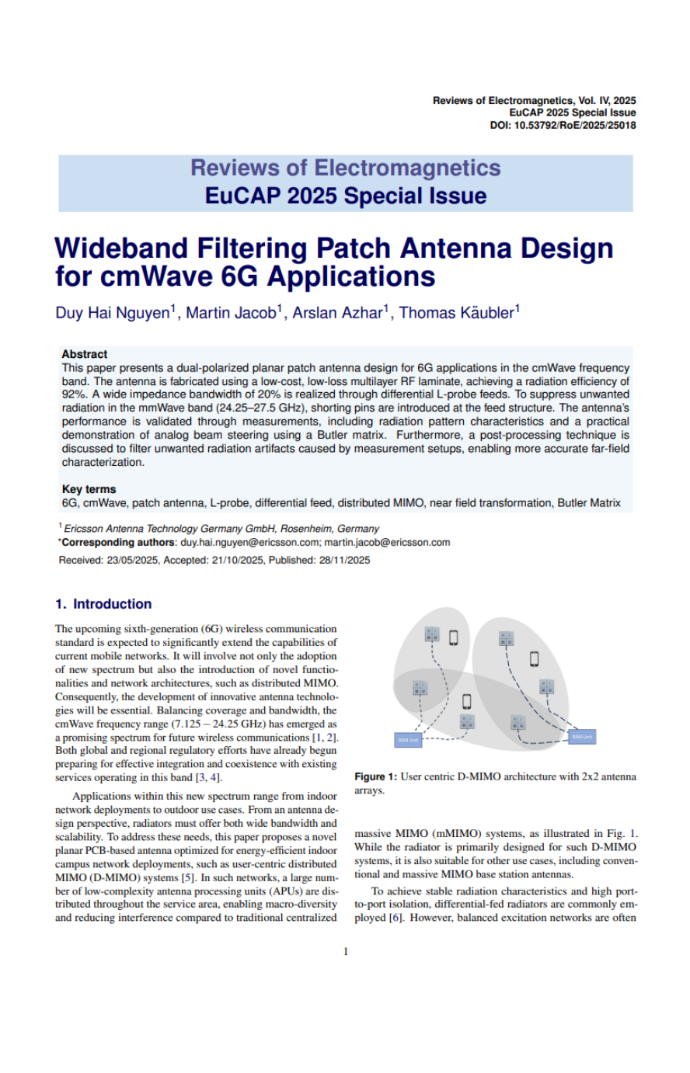
Wideband Filtering Patch Antenna Design for cmWave 6G Applications
Authors:
Duy Hai Nguyen, Martin Jacob, Arslan Azhar, Thomas Käubler
Abstract: This paper presents a dual-polarized planar patch antenna design for 6G applications in the cmWave frequency band. The antenna is fabricated using a low-cost, low-loss multilayer RF laminate, achieving a radiation efficiency of 92%. A wide impedance bandwidth of 20% is realized through differential L-probe feeds. To suppress unwanted radiation in the mmWave band (24.25–27.5 GHz), shorting pins are introduced at the feed structure. The antenna’s performance is validated through measurements, including radiation pattern characteristics and a practical demonstration of analog beam steering using a Butler matrix. Furthermore, a post-processing technique is discussed to filter unwanted radiation artifacts caused by measurement setups, enabling more accurate far-field characterization.
EuCAP 2025 SPECIAL ISSUE
Beam-Steered Channel Measurements at 160 GHz in an Industrial Environment
Authors:
Alper Schultze, Mathis Schmieder, Ramez Askar, Michael Peter, Wilhelm Keusgen, Taro Eichler
Abstract: This work presents further results of a channel measurement campaign carried out in a production hall of Rohde & Schwarz in Memmingen, Germany. The channel measurements were performed in the D-band at a carrier frequency of 160 GHz with a time domain correlation based channel sounder. The beam-steered channel measurements were analyzed and evaluated on the basis of identified beam pair realizations regarding MIMO capabilities, macro-diversity gains and blockage effects for a multi-transmitter industrial sub-terahertz communication system.
EuCAP 2025 SPECIAL ISSUE
Fast, Low-Invasive Visualization of EM-Very-Near-Field Distributions: from Anechoic Chamber to Microscope
Authors:
Jean-Charles Bolomey, Manuel Sierra-Castañer
Abstract: Fast and accurate visualization of Electromagnetic (EM) field distribution is satisfactorily obtained by numerical modelling. However, it still constitutes a key challenge in the case of measurements. The application of EM visualization covers a wide spectrum of demanding applications in wireless communications systems and sensing devices. EM visualization is an important tool in all the phases of the communications design steps: from the early design and prototyping of antenna modules to final on-line fabrication and compliance testing of mass-produced connected devices. In the last years, the measurement time has been drastically reduced thanks to several modalities exploiting either various interaction mechanisms between EM waves with adequate sensitive materials or the combination of standard Near-Field (NF) measurements with optimized sampling strategies and advanced wavefront post-processing techniques to retrieve Very-Near-Field (VNF) distributions. The aim of this extended paper is to provide an overview of these modalities and enable an initial assessment of their potential in terms of rapidity, sensitivity, invasiveness and spatial resolution.
EuCAP 2025 SPECIAL ISSUE
Performance Analysis for the Near Field Partial Characterization Approach for Aperture Antennas
Authors:
Amedeo Capozzoli, Claudio Curcio, Angelo Liseno
Abstract: In the framework of Near-Field Characterization a new approach has been recently proposed, devoted to the so called Partial Characterization: its aim is to retrieve the Far-Field pattern along some cuts only, by using a proper set of Near-Field data, “reduced”, with respect to the one adopted in the standard characterization approaches. In this paper a detailed analysis highlighting the capabilities of the approach is reported.