Volume 5, 2026

EuCAP 2025 SPECIAL ISSUE
Pin-Fin Heatsink Active Antenna Array With Joint Bandwidth Improvement, Footprint Miniaturization and Cooling Benefits
Authors:
Feza Turgay Celik, Alexander Yarovoy, Yanki Aslan
Abstract: This paper presents a novel heatsink antenna array architecture that addresses electromagnetic (EM) performance, antenna miniaturization, and thermal management challenges in antenna-on-substrate (AoS) configurations. By integrating tilted fin heatsinks onto rectangular patch antennas, the proposed unit element improves convective cooling while maintaining desirable radiation characteristics. A parametric analysis demonstrates that optimizing the fin tilt angle results in an 8 % reduction in the resonant frequency, effectively miniaturizing the antenna. To further enhance array performance, complementary split ring resonator (CSRR) walls are introduced between elements. These structures significantly reduce mutual coupling from approximately −9 dB to −15 dB and more than double the impedance bandwidth, increasing it from 3.3 % to 7.5 %. The results confirm improved radiation performance with a 12.7 % operational radiation pattern bandwidth centered at 24 GHz and stable gain across scan angles. On the thermal side, distributed chip placement and enhanced convective paths reduce chip temperatures from 97.3 °C to 70.3 °C for 1 W heat power per chip, and from 171.7 °C to 138.9 °C for 2 W heat power per chip under forced airflow conditions compared to the standard patch array. The proposed dual-functional design provides an efficient and compact solution for future high-power and thermally constrained antenna systems, with promising applications in 5G, radar, and mm-wave communication.
EuCAP 2026 SPECIAL ISSUE
Modal-Domain Design of Layered Multiport Waveguide Crossings Based on Transformation Optics
Authors:
Nona Messhenas, Werner L. Schroeder, Thomas Kaiser
Abstract: A systematic design methodology for transformation-optics-derived two-dimensional graded-index dielectric structures at millimeter-wave frequencies is presented using a modal-domain formulation. Instead of prescribing a bulk spatial permittivity distribution, the proposed approach specifies the local propagation velocity of the fundamental guided TE0 slab mode, yielding an equivalent spatial distribution of modal effective refractive index. The Maxwell’s fish-eye profile derived from transformation optics is mapped onto a layered dielectric configuration composed of mirror-symmetric two-material stacks selected from a precomputed lookup library. The approach explicitly considers fabrication-compatible layered realizations based on available dielectric materials and planar multilayer manufacturing constraints, ensuring compatibility with low-loss dielectric waveguide structures. An eight-port dielectric waveguide crossing operating at 77 GHz is used as a representative design example. Full-wave simulations indicate efficient transmission of the fundamental mode over the operating band, low crosstalk levels, and negligible higher-order mode conversion. The influence of dielectric loss and geometric design parameters is also investigated, confirming robust behavior under realistic material conditions. Compared with the preliminary conference contribution, this work introduces the modal-domain formulation, the layered dielectric synthesis strategy, and an extended performance analysis for multiport configurations. The presented framework provides a systematic approach for fabrication-compatible layered realizations of transformation-optics-derived guided-wave devices and supports scalable dielectric waveguide interconnects for 77 GHz automotive radar systems.
EuCAP 2026 SPECIAL ISSUE
A Deployable S-Band Yagi-Uda Antenna for a 3U CubeSat Based on a Pantograph Mechanism
Authors:
Conor M. Lambe, Geoffrey S. Hilton, Andrew C. M. Austin
Abstract: An eight element Yagi-Uda antenna utilising a deployable pantograph mechanism operating across the 2.4 GHz ISM band is proposed. The mechanism permits the antenna structure to stow into a compact volume prior to deployment, with a stowed volume of 29.7 cm3 and deployed-to-stowed length ratio of 6.7. The antenna and pantograph mechanism fits on the ‘small’ face of a 3U CubeSat (30 × 10 × 10 cm). In the fully deployed state the antenna presents a gain of 11.9 dBi at the operational frequency of 2.45 GHz, with an |S11| of −17.2 dB. The side lobe levels are measured to be −9.3 and −15 dB in the E and H plane respectively, and the corresponding beamwidths are 52.3° and 42.0°. A fractional bandwidth of 22.9% is found, and the measured results show a good agreement to the simulated results. The fabricated antenna performance is evaluated on a model of 3U CubeSat chassis, and additional measurements are taken in the case of a deployment failure. It is found that the antenna functions with slightly reduced performance in the case of a partial deployment failure, with a gain of 11.1 dBi, and moderately reduced performance in the case of a full failure, with a gain of 9.3 dBi.
EuCAP 2026 SPECIAL ISSUE
Multi-Beam GRIN Luneburg Lens Antenna for Millimeter-Wave Radar Sensing
Authors:
Mohammad Omid Bagheri, Veronica Leong, Justin Chow, Josh Visser, Yahia M. M. Antar, George Shaker
Abstract: Compact millimeter-wave radar modules are attractive front ends for short-range sensing owing to their small form factor, low cost, and wide modulation bandwidth. Their embedded antennas, however, provide limited effective aperture, moderate gain, and broad fixed radiation characteristics, which constrain wide-angle sector-resolved sensing when several radar channels operate simultaneously. This paper presents a passive multi-beam tailored GRIN Luneburg lens antenna in which five commercial FMCW radar modules simultaneously excite a single shared aperture. Although a conventional Luneburg lens effectively focuses individual feeds, its purely radial phase profile is not optimized to control the composite electromagnetic response of multiple simultaneously excited off-axis commercial radar feeds. The proposed TLL introduces fabrication-aware non-radial volumetric phase control to reorganize this composite response into predefined sensing sectors while also improving adjacent-channel isolation near the design frequency. A 10-cm-diameter lens is designed and fabricated for five 58–63 GHz radar modules targeting sectors centered at −56°, −28°, 0°, +28°, and +56°, corresponding to approximately 140° of sectorized angular coverage. Under simultaneous five-port excitation, full-wave simulations show that the CLL composite response exhibits substantial central crowding and displaced sector maxima, whereas the TLL forms five dominant lobes near the prescribed directions with peak realized gains of approximately 20–22 dB. The TLL also produces frequency-selective adjacent-channel coupling minima of approximately −50 to −70 dB near 60 GHz. Experimental validation demonstrates approximately 10–13 dB received-power enhancement across the operating band together with threshold-based sector-selective target detection. These results demonstrate a passive shared-aperture approach for simultaneous multi-beam millimeter-wave radar sensing using commercial radar-module feeds.
EuCAP 2026 SPECIAL ISSUE
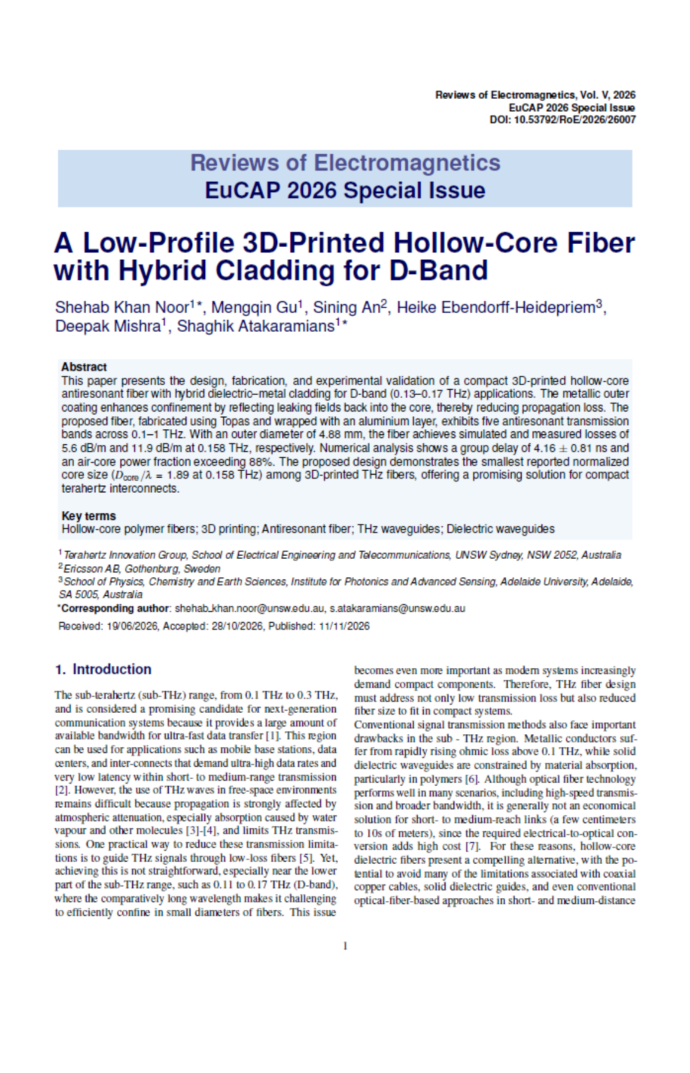
A Low-Profile 3D-Printed Hollow-Core Fiber with Hybrid Cladding for D-Band
Authors:
Shehab Khan Noor, Mengqin Gu, Sining An, Heike Ebendorff-Heidepriem, Deepak Mishra, Shaghik Atakaramians
Abstract: This paper presents the design, fabrication, and experimental validation of a compact 3D-printed hollow-core antiresonant fiber with hybrid dielectric–metal cladding for D-band (0.13–0.17 THz) applications. The metallic outer coating enhances confinement by reflecting leaking fields back into the core, thereby reducing propagation loss. The proposed fiber, fabricated using Topas and wrapped with an aluminium layer, exhibits five antiresonant transmission bands across 0.1–1 THz. With an outer diameter of 4.88 mm, the fiber achieves simulated and measured losses of 5.6 dB/m and 11.9 dB/m at 0.158 THz, respectively. Numerical analysis shows a group delay of 4.16 ± 0.81 ns and an air-core power fraction exceeding 88%. The proposed design demonstrates the smallest reported normalized core size (Dcore/λ = 1.89 at 0.158 THz) among 3D-printed THz fibers, offering a promising solution for compact terahertz interconnects.
EuCAP 2026 SPECIAL ISSUE
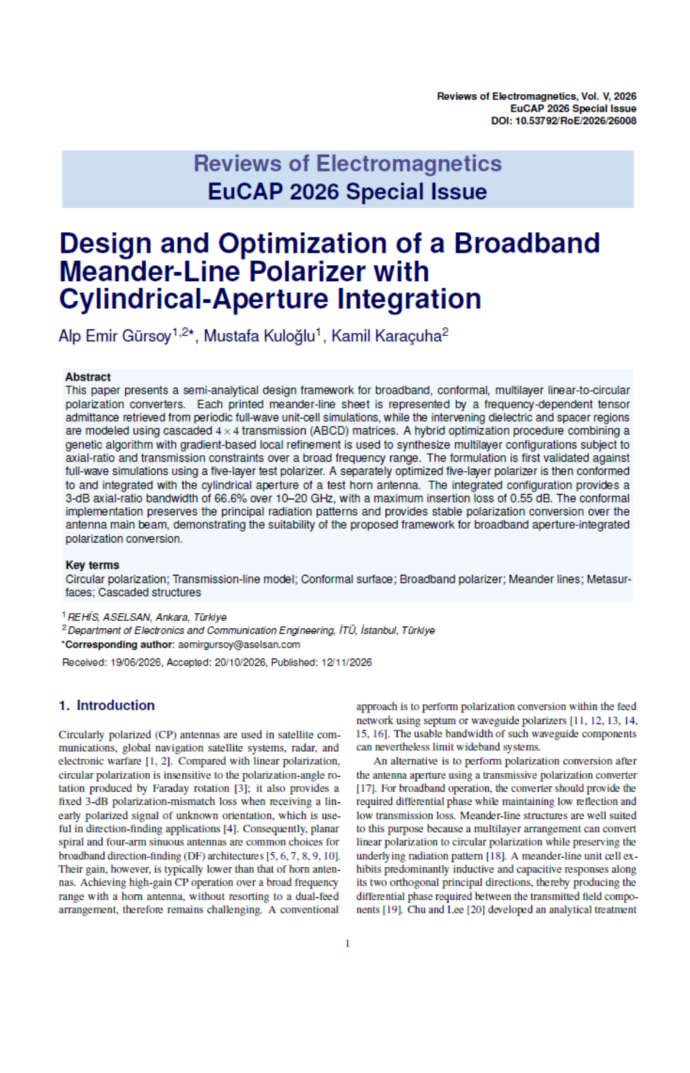
Design and Optimization of a Broadband Meander-Line Polarizer with Cylindrical-Aperture Integration
Authors:
Alp Emir Gürsoy, Mustafa Kuloğlu, Kamil Karaçuha
Abstract: This paper presents a semi-analytical design framework for broadband, conformal, multilayer linear-to-circular polarization converters. Each printed meander-line sheet is represented by a frequency-dependent tensor admittance retrieved from periodic full-wave unit-cell simulations, while the intervening dielectric and spacer regions are modeled using cascaded 4 × 4 transmission (ABCD) matrices. A hybrid optimization procedure combining a genetic algorithm with gradient-based local refinement is used to synthesize multilayer configurations subject to axial-ratio and transmission constraints over a broad frequency range. The formulation is first validated against full-wave simulations using a five-layer test polarizer. A separately optimized five-layer polarizer is then conformed to and integrated with the cylindrical aperture of a test horn antenna. The integrated configuration provides a 3-dB axial-ratio bandwidth of 66.6% over 10–20 GHz, with a maximum insertion loss of 0.55 dB. The conformal implementation preserves the principal radiation patterns and provides stable polarization conversion over the antenna main beam, demonstrating the suitability of the proposed framework for broadband aperture-integrated polarization conversion.
EuCAP 2026 SPECIAL ISSUE
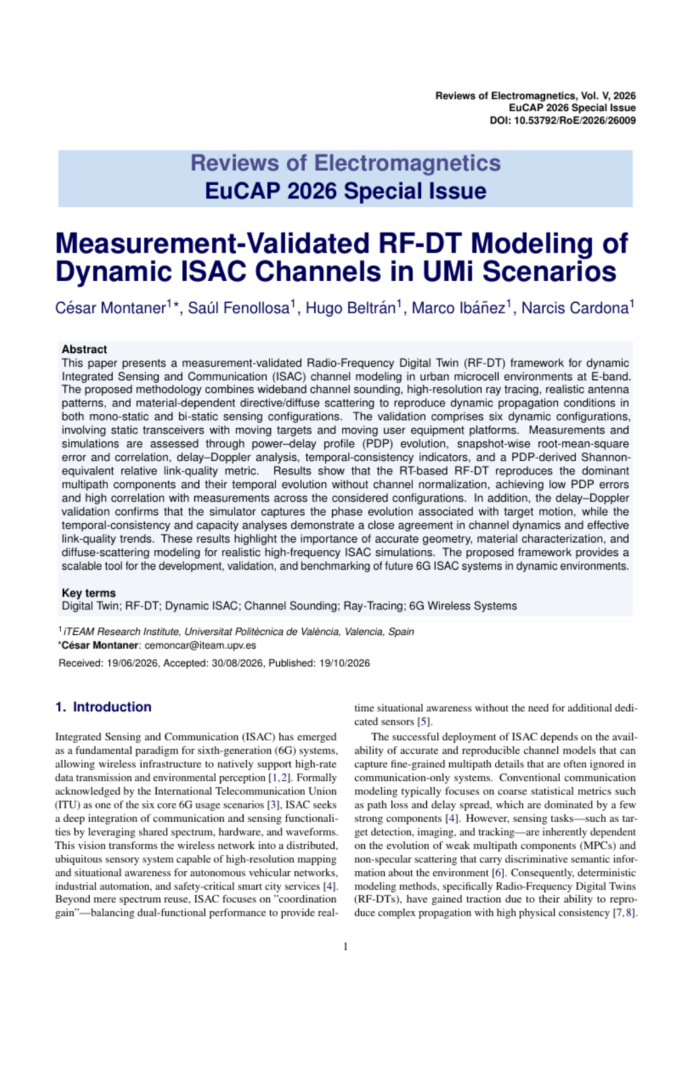
Measurement-Validated RF-DT Modeling of Dynamic ISAC Channels in UMi Scenarios
Authors:
César Montaner, Saúl Fenollosa, Hugo Beltrán, Marco Ibáñez, Narcis Cardona
Abstract: This paper presents a measurement-validated Radio-Frequency Digital Twin (RF-DT) framework for dynamic Integrated Sensing and Communication (ISAC) channel modeling in urban microcell environments at E-band. The proposed methodology combines wideband channel sounding, high-resolution ray tracing, realistic antenna patterns, and material-dependent directive/diffuse scattering to reproduce dynamic propagation conditions in both mono-static and bi-static sensing configurations. The validation comprises six dynamic configurations, involving static transceivers with moving targets and moving user equipment platforms. Measurements and simulations are assessed through power–delay profile (PDP) evolution, snapshot-wise root-mean-square error and correlation, delay–Doppler analysis, temporal-consistency indicators, and a PDP-derived Shannon-equivalent relative link-quality metric. Results show that the RT-based RF-DT reproduces the dominant multipath components and their temporal evolution without channel normalization, achieving low PDP errors and high correlation with measurements across the considered configurations. In addition, the delay–Doppler validation confirms that the simulator captures the phase evolution associated with target motion, while the temporal-consistency and capacity analyses demonstrate a close agreement in channel dynamics and effective link-quality trends. These results highlight the importance of accurate geometry, material characterization, and diffuse-scattering modeling for realistic high-frequency ISAC simulations. The proposed framework provides a scalable tool for the development, validation, and benchmarking of future 6G ISAC systems in dynamic environments.